Electronics troubleshooting increasingly happens at a bench that holds a laptop rather than a stack of benchtop boxes. PC-based oscilloscopes have become a practical alternative for technicians who need deep memory and strong resolution without surrendering desk space. Pico Technology has built a wide range of USB-powered scopes around this idea, and the PicoScope line shows how portability and measurement depth can coexist. This article looks at how the different series are structured and what each one brings to a diagnostic bench.
How PC-Based Oscilloscopes Fit Into a Diagnostic Workflow
A PC-based oscilloscope moves the display, controls, and processing onto a connected computer while the hardware itself handles only signal acquisition. That approach reduces the physical footprint on a workbench, since there is no built-in screen or bulky control panel to accommodate. Signals are captured by a compact USB unit and then shown, stored, and analyzed through dedicated software. This arrangement suits troubleshooting work because waveform captures can be saved directly to a drive, compared side by side, or shared with colleagues without photographing a screen.
Because the processing load sits on the host computer, these instruments also take advantage of whatever display resolution and screen size already sit on a desk. Pico Technology frames its range as a modern alternative to the traditional benchtop oscilloscope, built around a USB connection rather than a self-contained chassis. That design choice is part of why PC-based oscilloscopes have found a place in both field service kits and fixed lab setups.
PicoScope 2000 Series: Compact USB Oscilloscopes for Basic Testing
The PicoScope 2000 Series sits at the compact end of the range, built around 8-bit resolution and a small physical size. Channel counts run to 2 or 4, and mixed-signal (MSO) variants add 16 digital channels for logic-level work alongside those analog inputs. Bandwidth ranges from 10 to 100 MHz, sampling tops out at 1 GS/s, and memory depth stretches from 8 kS to 128 MS depending on the model chosen.
All units in this series are USB-powered, which removes the need for a separate mains supply on a bench or in the field. Each model also includes a built-in function generator and arbitrary waveform generator, so basic signal generation does not require a second instrument. The 2000B variants extend both memory and bandwidth beyond the base models, giving a bit more headroom for closer inspection of faster signals.
PicoScope 3000D and 3000E Series: High-Performance Digital Analysis
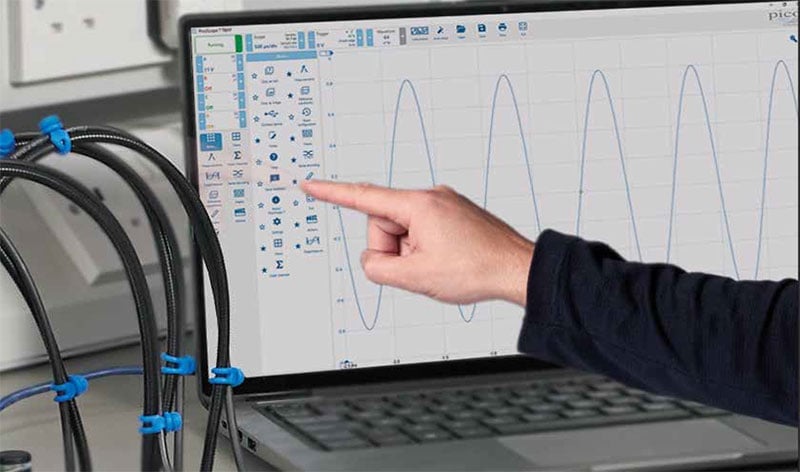
The PicoScope 3000D Series is described as general-purpose, combining fast sampling with what Pico Technology calls class-leading deep buffer memories for 8-bit instruments. Compared with the 2000 Series, the 3000D models push the bandwidth ceiling up to 200 MHz and the buffer memory as high as 512 MS, while sampling still tops out at 1 GS/s. As with the 2000 Series, channel counts come in 2 or 4, with MSO versions adding 16 digital channels, and every model includes a built-in function generator and AWG.
The 3000E Series moves further up in raw capability, offering what the brand positions as the highest-performance PC-based USB-powered oscilloscopes and MSOs in the lineup. These models fix channel count at 4 and raise sampling to 5 GS/s, five times the 3000D ceiling, while every unit carries a flat 2 GS of memory and a bandwidth window of 100 to 500 MHz. That combination of sampling speed and buffer depth is aimed at capturing longer, more complex digital sequences without losing detail at the edges of a waveform.
PicoScope 4000 Series and High-Resolution Measurements
Where the 2000 and 3000 families focus on 8-bit resolution, the PicoScope 4000 Series shifts toward higher resolution, spanning 12 to 16 bits depending on the model. This additional resolution is meant to deliver lower noise and distortion, which translates into closer signal fidelity when subtle waveform detail matters. Most models in the series also include a built-in arbitrary waveform generator, and like the rest of the range, all units draw power over USB.
For troubleshooting tasks that involve low-amplitude signals, sensor outputs, or noisy environments, higher bit resolution can make small variations easier to distinguish from background noise. The 4000 Series is the part of the lineup built specifically around that resolution requirement, rather than around raw bandwidth or channel count alone.
Built-In Tools and Software Features Across the Range
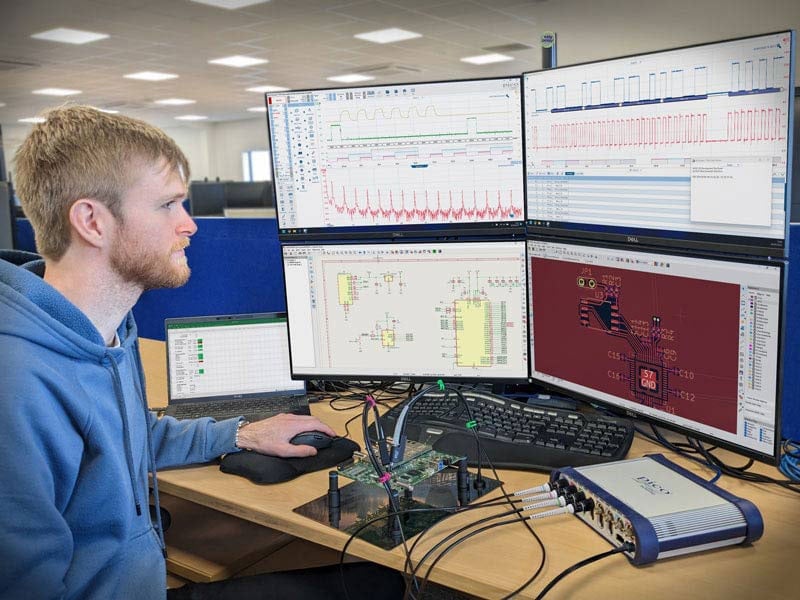
Across the PicoScope lineup, Pico Technology includes a consistent set of software tools rather than treating them as paid extras. High-end features such as serial decoding and mask limit testing come as standard, with 40 protocol decoders bundled into the software at no additional cost. PicoScope 7 software is free to download and runs across Windows, macOS, and Linux, which keeps a single workflow available regardless of the operating system on a given bench.
That cross-platform support matters in shared lab environments, including education settings, where Cambridge University has pointed to a common PicoScope user interface across scope ranges as a reason for standardizing on the equipment. Software upgrades have also historically added capability to existing hardware over time, rather than requiring a new purchase for every new feature. On top of that, Pico Technology includes a 5-year warranty as standard across the range, which is relevant to anyone weighing long-term reliability against the compact form factor.
Mixed-Signal and MSO Models for Complex Circuit Diagnosis
Mixed-signal oscilloscope variants extend the core 2000 and 3000D hardware rather than forming a separate product family, so the same digital-plus-analog configuration carries through both ranges. That combination allows a single instrument to observe an analog signal, such as a sensor output or supply rail, at the same time as the digital logic lines it interacts with. For circuits that mix analog sensing with digital control, this kind of simultaneous view can clarify timing relationships that would otherwise require two separate instruments.
Because the digital and analog channels share the same timebase and triggering system, an MSO model can correlate a glitch on a logic line with a corresponding dip or spike on an analog input. This is particularly relevant in embedded electronics work, where microcontroller outputs, communication buses, and analog peripherals often need to be checked together. Keeping the same software environment across MSO and non-MSO models also means a technician moving between instruments does not have to relearn a separate interface.
- The PicoScope 2000 Series offers 10 to 100 MHz bandwidth, up to 1 GS/s sampling, and 8 kS to 128 MS of memory, suited to compact general-purpose testing.
- The PicoScope 3000D Series extends bandwidth to 50 to 200 MHz with up to 512 MS of memory, aimed at general-purpose digital and analog diagnostics.
- The PicoScope 3000E Series provides 100 to 500 MHz bandwidth, up to 5 GS/s sampling, and a fixed 2 GS of memory across 4 channels for demanding capture work.
- The PicoScope 4000 Series trades raw bandwidth for 12 to 16-bit resolution, targeting applications where low noise and signal fidelity matter more than top sampling speed.
- MSO variants within the 2000 and 3000D families add 16 digital channels to the standard analog inputs, supporting combined analog and logic-level diagnosis.
Choosing among PC-based oscilloscopes generally comes down to matching bandwidth, memory depth, and resolution to the signals actually under investigation. The range spreads those trade-offs across distinct series rather than a single all-purpose model, which keeps the decision tied to the task at hand rather than to a generic feature list.
That spread of options is what keeps PC-based oscilloscopes relevant across such different corners of electronics work.